Computational Fluid Dynamics (CFD) is one of the principal areas of my research and technical expertise. My experience spans the mathematical formulation, numerical discretization, implementation, verification and application of computational methods for fluid-flow problems.
My work covers a broad range of CFD approaches, from depth-averaged shallow-flow models to three-dimensional Navier–Stokes solvers, turbulence-resolving simulations, multiphase flows and flows involving moving or immersed boundaries. I have experience with both structured and unstructured numerical methods and with Cartesian, boundary-fitted curvilinear and unstructured computational grids.
A significant part of my work is focused not only on applying existing CFD methods, but also on understanding and developing the underlying numerical algorithms, computational grids, pressure–velocity coupling methods, turbulence formulations and numerical solvers.
My experience includes the formulation and numerical solution of the governing equations of fluid motion using different discretization approaches.
Integrated CFD Expertise
My expertise in CFD combines a strong understanding of physical flow processes with advanced numerical modelling and scientific software development. I work across a broad spectrum of fluid-mechanics problems, including turbulent flows, free-surface and multiphase systems, particle-laden flows, aerodynamics, shallow flows, complex geometries and moving boundaries.
A particular strength of my work is turbulence modelling and turbulence-resolving simulation. My experience ranges from RANS approaches, including k–ε and k–ω models, to large-eddy simulation (LES), detached-eddy simulation (DES) and direct numerical simulation (DNS). This enables me to select the appropriate level of physical resolution for problems ranging from engineering-scale applications to detailed investigations of coherent turbulent structures and their interactions with particles, interfaces and solid boundaries.
My experience extends beyond the physical modelling itself. I develop numerical formulations for structured, unstructured, Cartesian and curvilinear systems, together with immersed-boundary, multiblock, hierarchical and locally refined approaches. I also work on pressure–velocity coupling, sparse linear systems, Krylov methods, multigrid and Algebraic Multigrid solvers.
This combination of fluid physics, turbulence, numerical analysis, computational geometry and solver development allows me to approach CFD as an integrated computational science, from understanding the underlying physical processes to developing robust numerical methods and implementing them in efficient scientific software.
Areas of Expertise
Numerical Methods for Fluid Dynamics
My work covers a broad range of numerical methods, from spatial and temporal discretization to pressure–velocity coupling, iterative solution techniques and multilevel solvers for large computational systems.
Finite Volume Method (FVM)
Finite Difference Method (FDM)
Finite Element Method (FEM)
Spectral methods
Spatial discretization of advection and diffusion
Staggered and collocated variable arrangements
Explicit and implicit temporal discretization
Iterative solution methods
Multigrid techniques
Krylov Space methods
In developing numerical methods, I place particular emphasis on conservation, consistency, accuracy, numerical stability, convergence and computational efficiency. Verification against analytical solutions, manufactured solutions and established benchmark problems is an important part of this development process.
Algorithms
A particular focus of my work is selecting and developing numerical approaches that combine geometrical flexibility, computational efficiency, numerical accuracy and scalability for complex two- and three-dimensional flow problems.
Modelling on structured grids
Modelling on unstructured grids
Cartesian-grid methods with octree-based refinement
Generalized boundary-fitted curvilinear methods
Multiblock and nested-grid methods
Hierarchical grid methods
Adaptive mesh refinement techniques
Local grid refinement and coarsening
Moving and deforming computational domains
Immersed-boundary techniques
Algebraic and Elliptic grid generation
These different computational approaches allow the numerical formulation to be adapted to the characteristics of the physical problem. Structured Cartesian and curvilinear approaches provide efficiency and systematic data organization, while unstructured methods provide greater geometrical flexibility. Multiblock, nested, hierarchical and adaptive approaches enable computational resolution to be concentrated in regions where the flow physics or geometrical complexity requires greater detail.
Turbulence Modelling
I have experience with turbulence modelling across a broad range of fidelity levels, from Reynolds-averaged approaches for practical engineering applications to scale-resolving methods for detailed investigation of unsteady turbulent structures.
Reynolds-Averaged Navier–Stokes (RANS) modelling
RANS k–ε turbulence models
RANS k–ω turbulence models
Large Eddy Simulation (LES)
Detached Eddy Simulation (DES)
Direct Numerical Simulation (DNS)
Eddy-viscosity turbulence formulations
Reynolds-stress representation
Subgrid-scale modelling for LES
Near-wall treatment and wall functions
Resolved turbulent structures
Turbulence modelling on complex geometries
Turbulence interaction with particles and interfaces
These approaches provide different balances between computational cost and physical resolution. RANS models are suitable for many engineering-scale simulations, while LES and DES provide access to important unsteady turbulent structures.
High-Performance Computing (HPC)
HPC is an integral part of my CFD research, particularly for high-resolution turbulence simulations, large computational grids, particle-laden flows and simulations requiring long physical or morphodynamic integration times.
Develop parallel algorithms
Shared-memory computing, OpenMP
MPI-based parallelization, MPI
CPU-based high-performance computing
GPU computing and acceleration
Work on supercomputers
Computational clusters
Cloud computing
Large scientific datasets and simulation output
High-performance scientific software in C++ and Fortran
I have worked on the Shaheen and Snellius supercomputers, as well as cloud-based HPC environments on Amazon Web Services (AWS). My experience also extends to the design, construction and configuration of local computing clusters for parallel scientific applications.
My HPC work is closely integrated with numerical-method and scientific software development, particularly for computationally intensive three-dimensional CFD, turbulence-resolving simulations, particle-based modelling and large sparse systems.
Computational Fluid Dynamics connects the underlying physics of fluid motion with mathematical models, numerical methods and computational algorithms. My work covers this complete modelling chain, from understanding the physical processes to developing and applying numerical solutions for complex two- and three-dimensional flows.
The relevant physical processes and dominant flow mechanisms are identified, including turbulence, free-surface effects, multiphase interactions, particle dynamics and interaction with solid boundaries.
The physical problem is formulated mathematically using the appropriate governing equations, such as the Navier–Stokes or shallow-water equations, together with suitable turbulence and constitutive models.
The governing equations are discretized using methods such as finite volume, finite element or spectral approaches on structured, unstructured, Cartesian or curvilinear computational grids.
Pressure–velocity coupling, boundary conditions and the resulting sparse algebraic systems are treated using appropriate numerical algorithms, iterative solvers and multigrid techniques.
The resulting CFD model is verified, validated and analysed to assess numerical accuracy and to extract physically meaningful information from the simulated flow.
My expertise therefore combines physical understanding with turbulence modelling, numerical analysis, computational geometry, solver development and high-performance computing. This allows me to approach CFD problems from both the physical and computational perspectives rather than treating the numerical model as a black-box simulation tool.
I developed and applied Computational Fluid Dynamics methods based on
Cartesian grids with local refinement. The objective is to retain the
simplicity, accuracy and computational efficiency of Cartesian
discretization while providing substantially higher spatial resolution
only in regions where it is physically or geometrically required.
Rather than refining the complete computational domain uniformly,
the grid is refined locally around complex boundaries and regions
containing important flow structures. This makes it possible to
resolve small-scale flow features while limiting the computational
cost associated with a globally fine mesh.
Structured Cartesian CFD
Locally refined Cartesian grids
Hierarchical grid structures
Multiple levels of spatial resolution
Local refinement and coarsening
Fine resolution near complex geometries
Refinement around important flow structures
Three-dimensional incompressible flow
Finite-volume discretization
Pressure–velocity coupling
Pressure Poisson equation
Multigrid solution techniques
Large Eddy Simulation (LES)
Immersed-boundary treatment of complex geometries
Efficient memory organization
High-performance implementation
Local Refinement Strategy
The key advantage of this approach is that computational resolution
can be concentrated where it contributes most to the accuracy of the
solution. Regions containing steep velocity gradients, boundary
layers, separated flow, wakes, vortical structures or geometrically
complex boundaries can be represented at a finer level, while regions
containing comparatively smooth flow remain on coarser grids.
This creates a computational hierarchy in which different parts of
the same domain can be solved at different spatial resolutions while
remaining part of a consistent numerical flow solution.
Complex Geometries on Cartesian Grids
Cartesian grids are particularly attractive from a numerical and
computational perspective, but conventional Cartesian meshes do not
naturally conform to curved or irregular boundaries. I therefore
combine the Cartesian-grid methodology with immersed-boundary
techniques, enabling geometrically complex objects to be represented
without constructing a fully body-fitted mesh.
Local refinement can then be applied around the immersed geometry,
providing increased resolution precisely where the interaction
between the flow and the solid boundary is strongest.
Multilevel Numerical Solution
The hierarchical nature of the computational grid also connects
naturally with multilevel numerical solution techniques. In
incompressible flow calculations, large sparse systems arising from
the pressure equation can be solved efficiently using multigrid
strategies operating across different spatial scales.
The combination of Cartesian discretization, local refinement,
immersed boundaries and multigrid provides a powerful framework for
high-resolution CFD: geometrical complexity and small-scale flow
structures can be resolved where necessary without imposing the cost
of uniformly increasing the resolution throughout the entire domain.
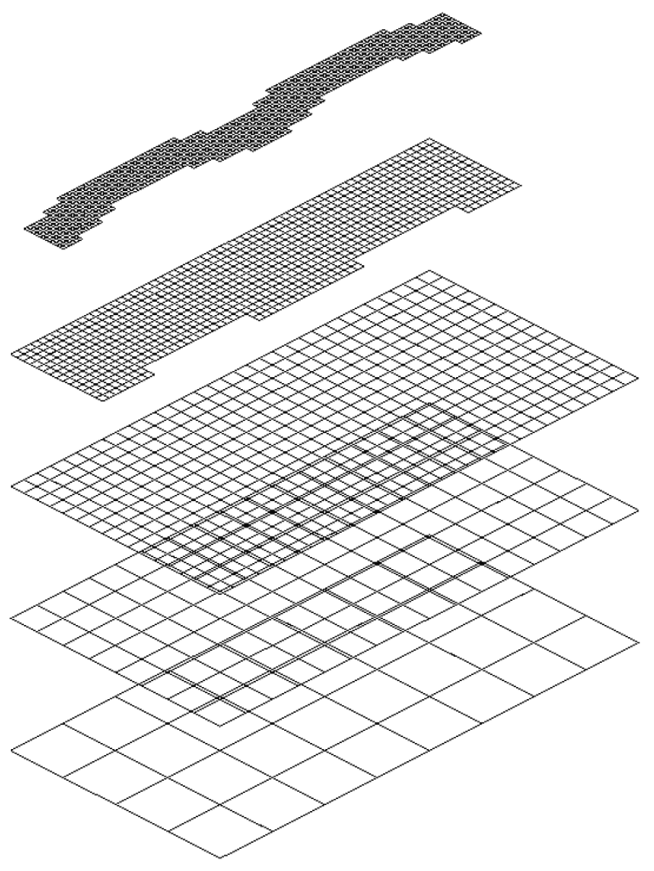
Example of a Cartesian computational grid with local refinement. It forms multi-level grid which can be solved by multigrid solver.
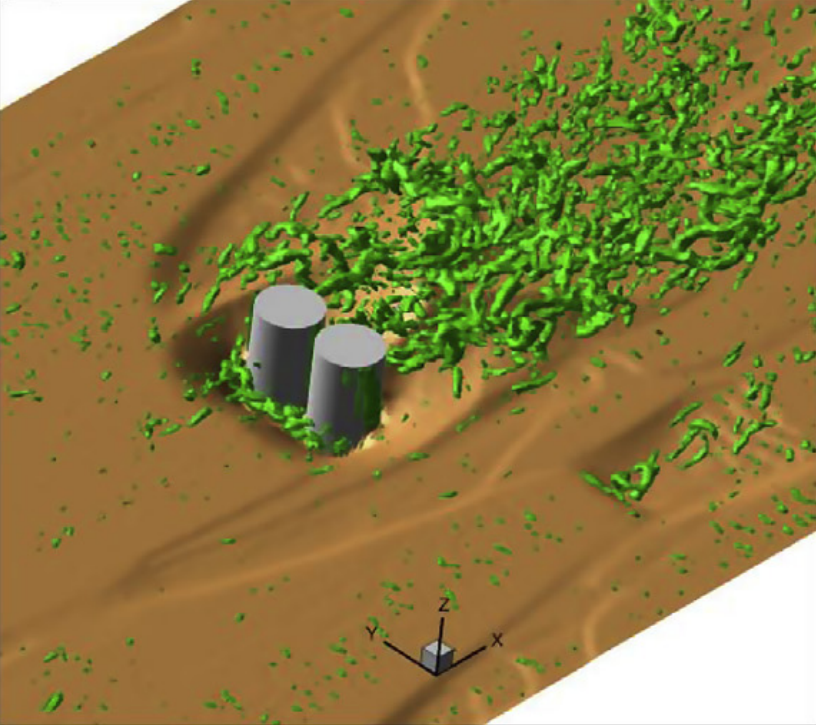
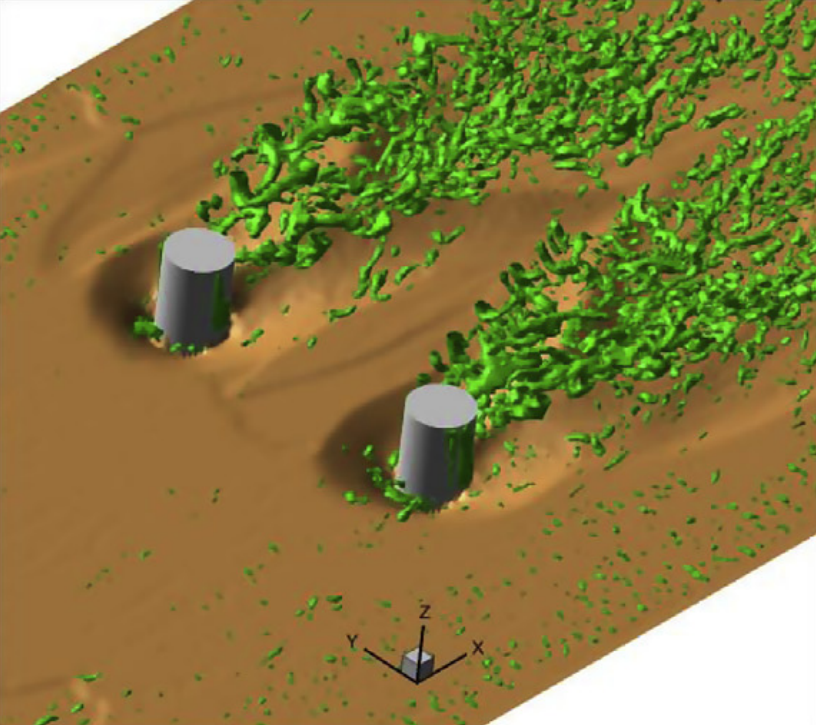
Simulation
CFD simulation using locally refined Cartesian grids, illustrating
how computational resolution is concentrated around regions with
complex flow physics and geometry.
Turbulence modelling by LES and visualization of the coherent structure of turbulence. The grid is locally refined around the structures.
02 · Curvilinear CFD
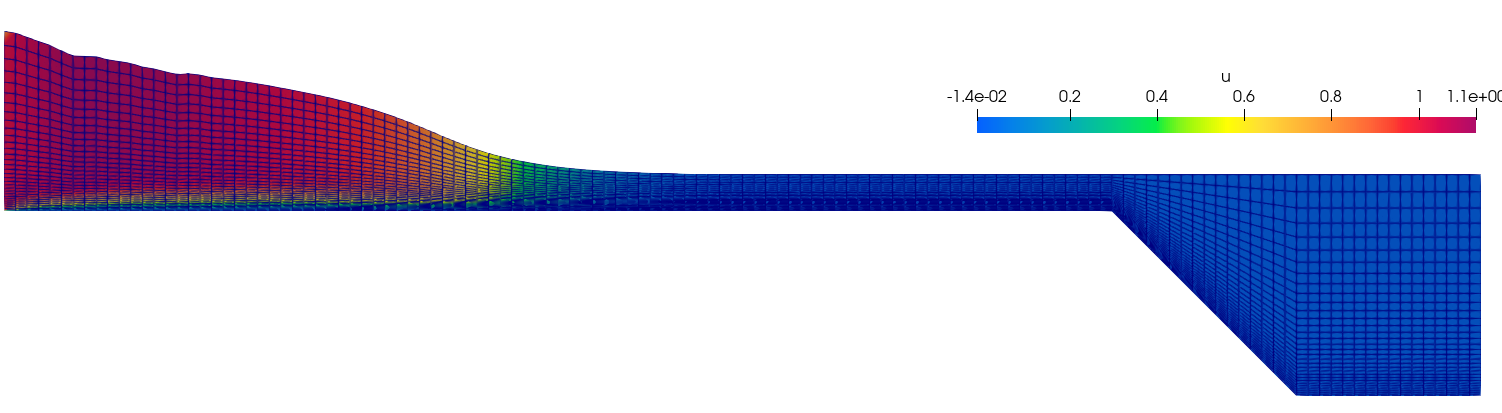
2DV Free-Surface Flow Solver on Curvilinear Grids
I developed a two-dimensional vertical (2DV) Computational Fluid
Dynamics solver for free-surface flows using a boundary-fitted
curvilinear coordinate system. The solver is designed for problems
in which both the flow field and the computational domain evolve
dynamically, requiring an accurate treatment of the free surface
and complex geometrical boundaries.
The governing flow equations are formulated in generalized
curvilinear coordinates and discretized using the Finite Volume
Method. This provides a flexible numerical framework in which the
computational grid can follow the geometry of the physical domain
while retaining the efficiency and systematic structure of a
body-fitted mesh.
Two-dimensional vertical (2DV) flow modelling
Incompressible Navier–Stokes equations
Generalized curvilinear coordinate system
Boundary-fitted structured grids
Finite Volume Method (FVM)
Free-surface flow modelling
Moving and deforming computational grids
Dynamic adaptation of the grid to the free surface
Pressure–velocity coupling
Pressure Poisson equation
Spatial discretization of advection and diffusion
Implicit time integration
Complex boundary conditions
Strongly varying flow properties
Geometric multigrid solution
Transient flow simulation
Numerical verification and benchmark testing
Curvilinear Coordinate Formulation
The use of generalized curvilinear coordinates allows the physical
geometry to be mapped onto a regular computational domain. The
governing equations are transformed accordingly, including the
appropriate metric coefficients and Jacobian terms required to
represent derivatives, fluxes and conservation laws in the
transformed coordinate system.
This approach combines the geometrical flexibility of a
boundary-fitted formulation with the computational advantages of
structured-grid numerical methods.
Dynamic Free-Surface Grid
The upper boundary of the computational domain evolves with the
calculated free-surface position. The curvilinear grid therefore
adapts dynamically as the free surface changes, allowing the
computational domain to follow the evolving fluid region without
introducing a fixed Cartesian approximation of the surface.
Efficient Numerical Solution
An important aspect of the solver is the efficient treatment of
the algebraic systems arising from the flow equations. Geometric multigrid
solver is used to accelerate convergence, particularly
for the pressure solution associated with incompressible flow.
The solver therefore integrates the complete numerical chain:
physical flow modelling, curvilinear transformation, finite-volume
discretization, moving-grid treatment, pressure–velocity coupling,
multigrid acceleration and transient free-surface simulation.
This ongoing project extends my existing two-dimensional vertical
(2DV) curvilinear flow solver to a fully three-dimensional CFD
framework. The objective is to retain the numerical flexibility and
boundary-fitted character of the 2DV formulation while enabling the
simulation of genuinely three-dimensional flow structures and
geometrically complex domains.
The solver is being formulated in generalized three-dimensional
curvilinear coordinates. The governing flow equations are transformed
from physical space to computational space and discretized on a
structured, boundary-fitted grid. This provides an efficient framework
for representing curved and irregular geometries without sacrificing
the advantages of structured numerical methods.
Extension from 2DV to fully three-dimensional flow
High-performance implementation for large three-dimensional problems
Three-Dimensional Curvilinear Formulation
Moving from 2DV to three dimensions considerably increases the
mathematical and computational complexity of the solver. The
transformation must account for the complete three-dimensional
geometry, including all metric terms, cross-derivative contributions
and coupling between the three velocity components.
The resulting formulation is intended to support complex geometries
while maintaining conservation and numerical consistency within a
structured finite-volume framework.
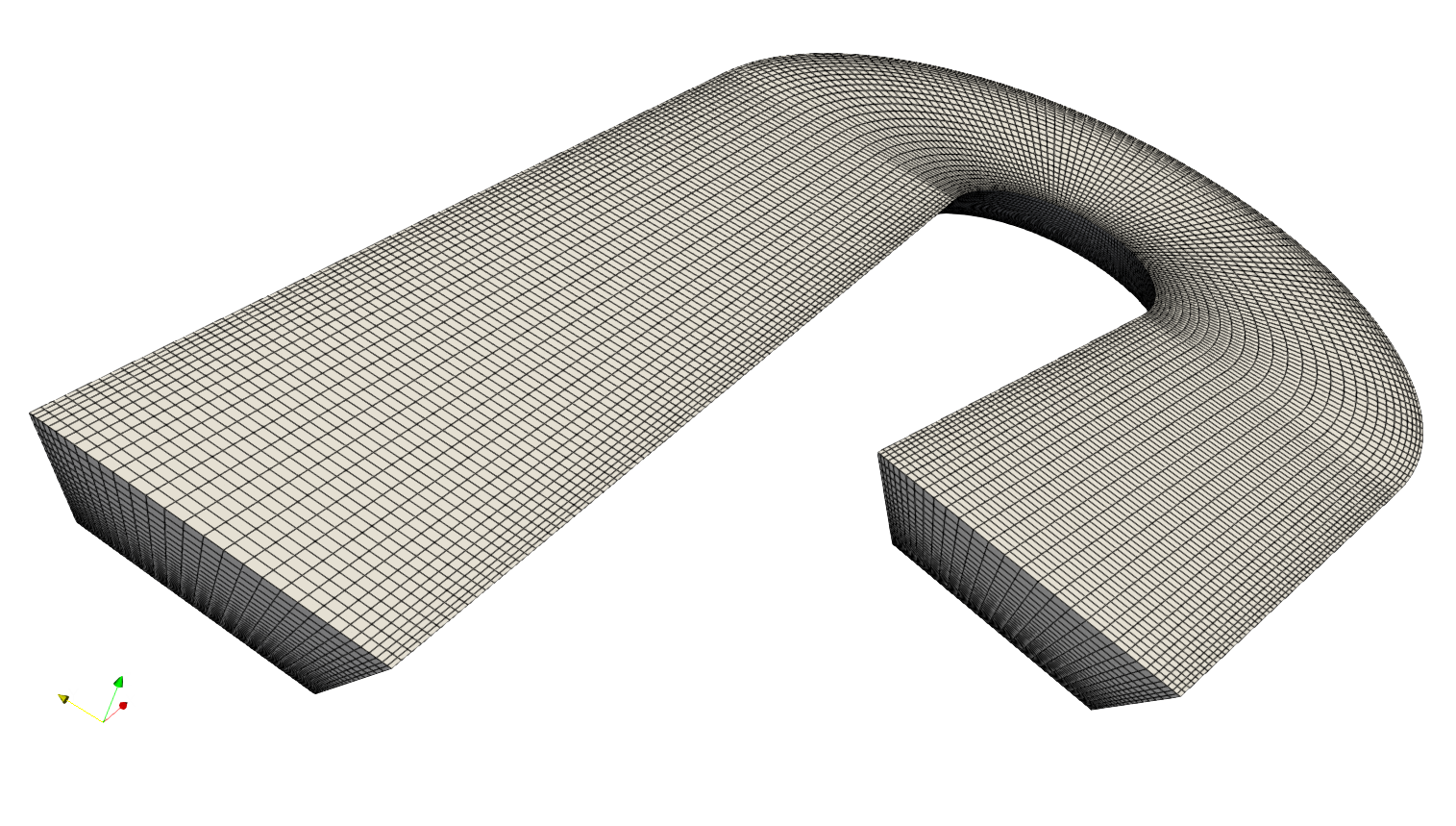
3D Curvilinear Grid Infrastructure
An important component of the project is the development of the
numerical infrastructure required to represent and operate on
three-dimensional curvilinear grids. This includes the computation
of geometrical quantities, cell metrics, face properties and the
transformations required by the governing equations.
The grid formulation is designed to support boundary-fitted domains
such as curved channels and other geometrically complex flow regions,
while retaining a logically structured computational topology.
Pressure Solution and Multigrid
The three-dimensional pressure equation produces a substantially
larger sparse algebraic system than in the 2DV formulation.
Efficient pressure solution is therefore an important part of the
solver development.
BiCGStab with multigrid as preconditioner is being incorporated
to provide an efficient numerical framework for large three-dimensional
simulations and to prepare the solver for future high-performance
computing applications.
Verification Strategy
The solver is being developed together with dedicated verification
cases. Analytical and manufactured solutions provide controlled tests
for the transformed equations, metric terms, discretization,
boundary conditions and pressure solution before the model is applied
to increasingly complex physical flow problems.
This step-by-step verification is particularly important for a
three-dimensional curvilinear formulation because geometrical
transformations and discretization errors must be distinguished from
errors in the underlying flow solution.
3D curvilinear formulation →
3D grid and metric infrastructure →
Navier–Stokes discretization →
Pressure–velocity coupling →
Multigrid solution →
Verification → Complex 3D CFD applications
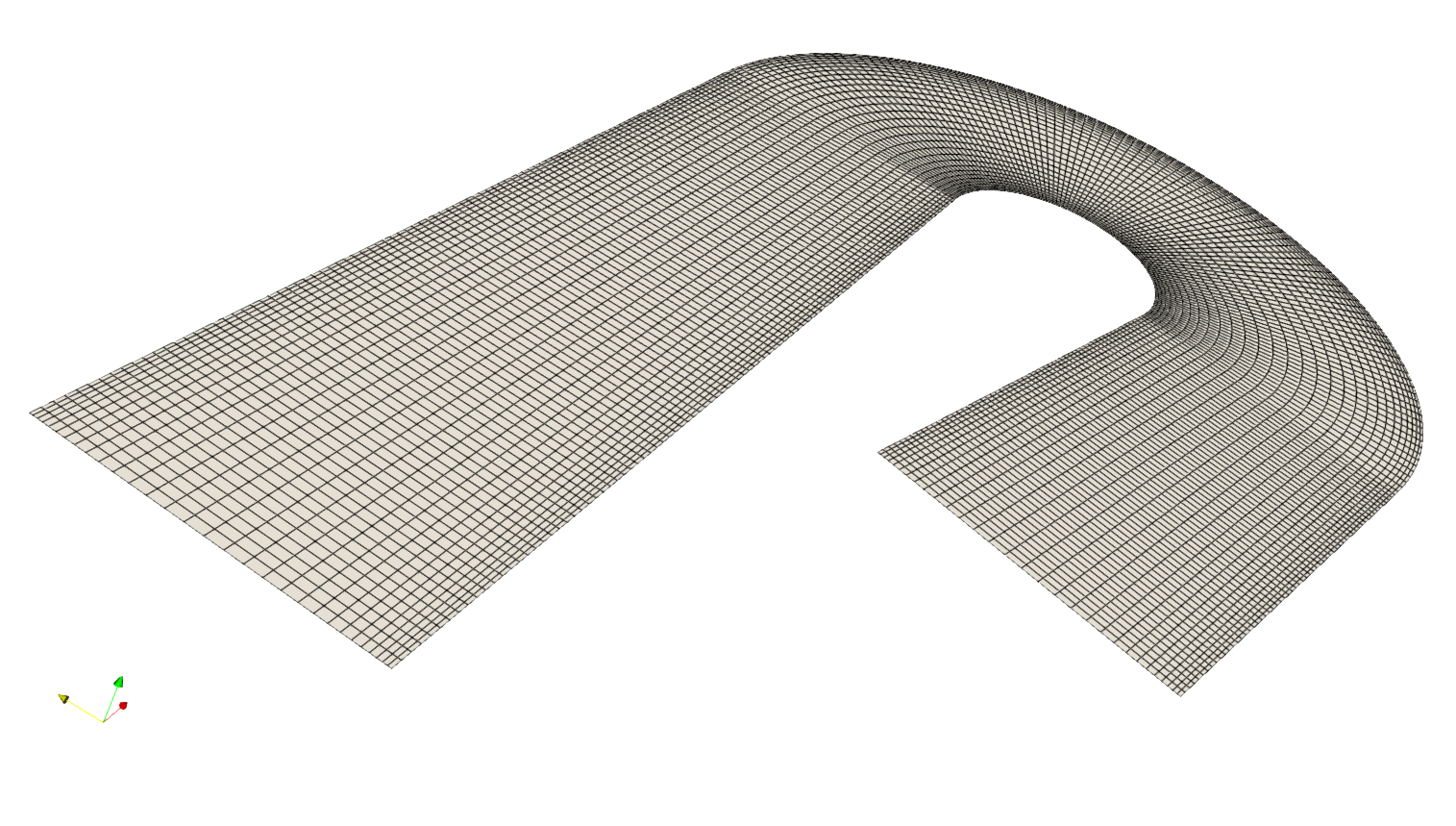
Three-dimensional boundary-fitted curvilinear grid for the
ongoing development of the 3D flow solver.
04 · Voronoi CFD Development
CFD Solver on Unstructured Voronoi Grids
This ongoing project concerns the development of a two- and
three-dimensional Computational Fluid Dynamics solver based on
unstructured Voronoi grids. The objective is to combine the
geometrical flexibility of unstructured meshes with the strong
orthogonality properties of Voronoi–Delaunay grid systems.
The solver addresses the full incompressible Navier–Stokes equations
using a collocated finite-volume arrangement. Pressure and velocity
variables are stored at the same cell centres, while fluxes and
gradients are evaluated across the polygonal or polyhedral cell
faces.
Voronoi–Delaunay Grid Geometry
The computational grid is constructed from a Voronoi tessellation
and its associated Delaunay dual. A fundamental property of this
arrangement is that the line connecting two neighbouring cell
centres is orthogonal to their common Voronoi face.
The common face lies on the perpendicular bisector of the link
between the two generating points. Consequently, the adjacent
cell centres are located at equal normal distances from that
face. This provides a favourable geometrical basis for symmetric
interpolation, gradient reconstruction and conservative flux
calculation.
For sufficiently regular grids, this midpoint and orthogonality
property supports second-order face interpolation without the
non-orthogonal correction terms commonly required on general
unstructured meshes. It also supports symmetric discrete
operators and energy-consistent treatment of pressure and
momentum fluxes.
Two- and three-dimensional CFD solver development
Unstructured Voronoi grids
Voronoi–Delaunay dual-grid geometry
Orthogonal cell-centre connections and cell faces
Midpoint face interpolation
Second-order spatial interpolation
Conservative finite-volume discretization
Collocated pressure and velocity arrangement
Full incompressible Navier–Stokes equations
Pressure–velocity coupling
Face-normal mass and momentum fluxes
Discrete conservation of mass and momentum
Energy-consistent numerical formulation
Polygonal cells in two dimensions
Polyhedral cells in three dimensions
Large Eddy Simulation for three-dimensional flows
Proposed RANS capability for two-dimensional flows
Algebraic Multigrid pressure solver
Sparse matrix assembly on unstructured connectivity
Verification and benchmark testing
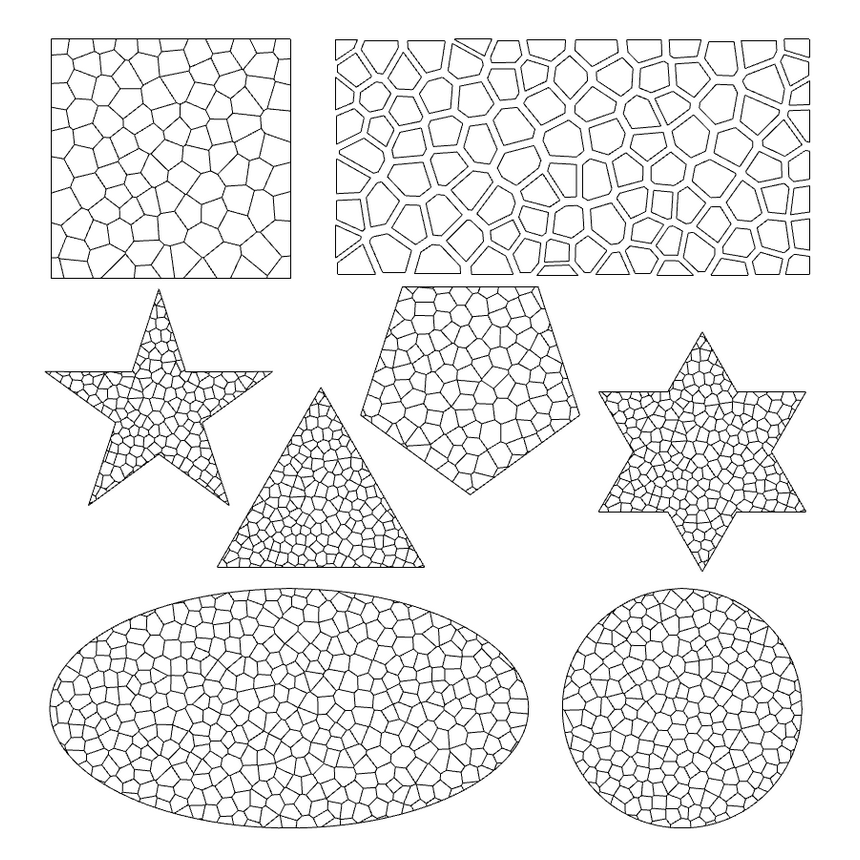
Two-Dimensional Voronoi Formulation
In two dimensions, the Voronoi tessellation produces a domain of
polygonal control volumes. For reasonably uniform point
distributions, many interior cells are approximately hexagonal,
although the framework supports general polygons with different
numbers of faces.
The polygonal control volumes provide flexibility for representing
irregular domains while maintaining an orthogonal relation between
neighbouring cell centres and their shared faces. The two-dimensional
solver is intended to support Reynolds-Averaged Navier–Stokes
formulations for practical engineering-flow simulations.
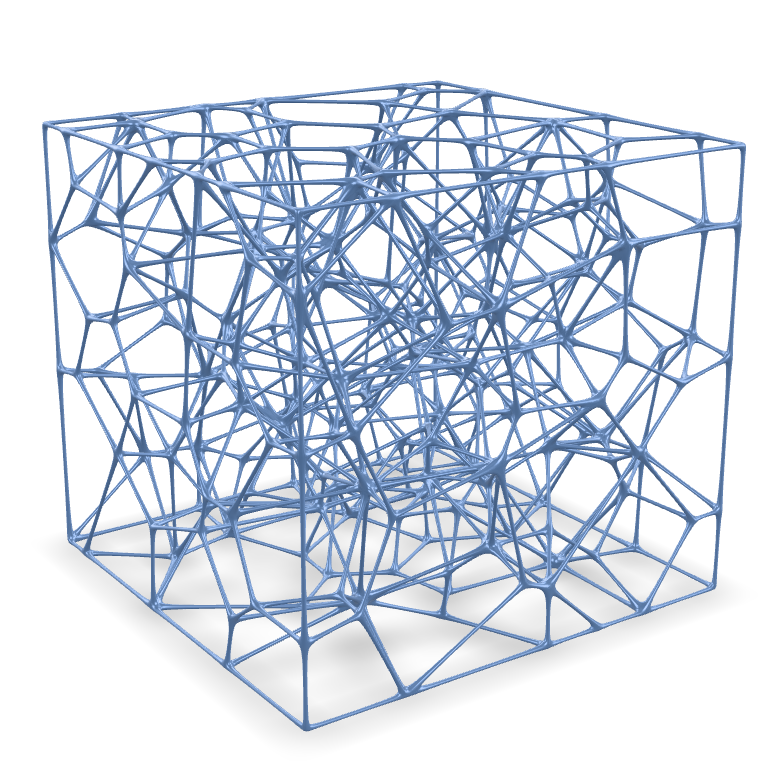
Three-Dimensional Extension
The three-dimensional solver extends the Voronoi construction from
polygonal cells to general polyhedral control volumes. Neighbouring
cells share planar polygonal faces, and the line connecting their
generating points remains normal to the corresponding face.
Extending the method to three dimensions requires a complete
polyhedral-mesh infrastructure, including cell volumes, face areas,
outward normals, cell-to-face connectivity, neighbouring-cell
relationships, boundary-face treatment and conservative flux
assembly.
The three-dimensional formulation is being developed for
turbulence-resolving simulations using Large Eddy Simulation.
This requires accurate treatment of momentum transport and velocity
gradients while preserving the conservative and orthogonal
advantages of the Voronoi grid.
Collocated Flow Arrangement
Pressure and all velocity components are stored at the Voronoi cell
centres. This collocated arrangement simplifies the data structure
and is well suited to general polygonal and polyhedral control
volumes.
The numerical formulation must nevertheless provide stable coupling
between pressure and velocity and prevent non-physical pressure
oscillations. The ongoing development therefore includes appropriate
face-flux reconstruction and pressure-correction techniques designed
for the collocated Voronoi framework.
Algebraic Multigrid Solver
Discretization of the pressure equation produces a large sparse
algebraic system whose connectivity follows the unstructured
Voronoi mesh. Algebraic Multigrid is being developed as the principal
solution strategy because it constructs its multilevel hierarchy
from the matrix itself rather than requiring a geometrically defined
sequence of coarse grids.
This makes AMG particularly suitable for the irregular polygonal and
polyhedral connectivity of the Voronoi framework. The goal is to
obtain a scalable pressure solution while preserving robustness as
the mesh size and geometrical complexity increase.
Ongoing Development
The project is currently under development. The work includes the
construction of the Voronoi mesh infrastructure, derivation of the
finite-volume operators, pressure–velocity coupling, sparse matrix
assembly, AMG integration, boundary-condition implementation and
systematic verification of the two- and three-dimensional solvers.
The longer-term objective is a unified CFD framework that combines
unstructured geometrical flexibility with orthogonal finite-volume
discretization, accurate face interpolation, conservative transport
and efficient multilevel solution methods.
Generating points → Delaunay connectivity →
Voronoi polygonal or polyhedral cells →
Orthogonal finite-volume discretization →
Collocated Navier–Stokes solution →
Algebraic Multigrid →
RANS and LES simulations
Two-dimensional Voronoi grid with polygonal control volumes.
The links between neighbouring generating points are normal to
their shared Voronoi faces.
Three-dimensional extension of the Voronoi framework, producing
polyhedral cells separated by planar polygonal. Source: https://mrtn.ch/div/voronoi-box/
From Fundamental Fluid Physics to Predictive CFD
My CFD work bridges fundamental fluid mechanics and practical
computational modelling. At the detailed level, high-resolution
simulations provide insight into turbulence, coherent flow
structures, boundary interactions, free-surface dynamics and
particle–flow interactions. At the engineering level, efficient
numerical methods and reduced modelling approaches are required
for larger domains, longer simulation times and practical
applications.
An important objective of my work is therefore not only to develop
increasingly detailed CFD models, but also to use them as numerical
laboratories for understanding the underlying physics, evaluating
modelling assumptions and improving computational methods. Detailed
simulations provide a reference against which lower-resolution
formulations, turbulence closures and numerical approximations can
be assessed.
This approach connects physical understanding with numerical-method
development and high-performance computing. Its broader value lies in:
Resolving fundamental flow mechanisms and coherent structures
Investigating turbulence and turbulence–boundary interactions
Evaluating assumptions used in reduced-order and engineering CFD models
Assessing turbulence closures and numerical approximations
Developing accurate and conservative discretization methods
Improving pressure–velocity coupling and numerical solvers
Developing efficient multigrid and Algebraic Multigrid techniques
Investigating structured, curvilinear and unstructured CFD formulations
Verifying numerical methods against analytical and benchmark solutions
Scaling computational methods towards large three-dimensional simulations
Translating detailed physical understanding into robust engineering models
Fundamental fluid physics → High-fidelity CFD →
Process understanding → Numerical-method development →
Verification and validation → HPC implementation →
Predictive engineering CFD
Overall CFD Expertise
My expertise in Computational Fluid Dynamics spans the complete
modelling chain, from understanding the underlying physical processes
to mathematical formulation, numerical discretization, solver
development, high-performance implementation and interpretation
of complex flow simulations.
This combination enables me to work across CFD from
fundamental fluid mechanics and turbulence to the development
of complete numerical solvers and large-scale computational
simulations.
A common thread throughout my work is that I do not treat CFD
simply as the application of existing simulation software.
I am particularly interested in the connection between the
physical processes, mathematical equations, computational
representation and numerical algorithms that ultimately determine
the accuracy, robustness and efficiency of a flow simulation.
My work therefore integrates fluid physics, turbulence modelling, numerical analysis, computational geometry, solver development, scientific software engineering and high-performance computing, allowing me to approach complex flow problems from both a fundamental research perspective and a practical engineering perspective.