My research in sediment transport and morphodynamics represents a world-class, highly innovative programme of physics-based computational modelling. It advances beyond conventional sediment-transport approaches by explicitly connecting turbulent flow, individual grain motion, sediment sorting and riverbed evolution within a unified numerical framework.
Sediment transport and morphodynamics form a central part of my research. My work focuses on understanding and modelling the physical processes through which flowing water entrains, transports and deposits sediment, and how these processes collectively reshape riverbeds, channels and other sedimentary environments.
A distinguishing feature of my research is the explicit connection between turbulent flow, individual sediment particles and large-scale morphological development. Rather than relying exclusively on equilibrium transport formulas, I develop process-based numerical models in which sediment pickup, particle motion, suspension, deposition and bed evolution are treated as interconnected physical processes.
My work spans fundamental process research, numerical-method development, high-resolution simulation and application-oriented morphodynamic modelling.
Innovation and International Distinction
The foundations of this research were established in my PhD work through a three-dimensional, high-resolution and fully process-based framework coupling Large Eddy Simulation, discrete Lagrangian sediment particles, locally refined Cartesian grids, immersed boundaries and dynamically evolving morphology. The framework was successfully demonstrated for the spontaneous generation and migration of ripples and dunes and subsequently extended to strongly three-dimensional morphodynamic applications.
My current research advances this methodology from uniform sediment to graded mixtures containing multiple grain-size fractions. It incorporates size-selective entrainment and deposition, hiding–exposure effects, particle interlocking, active-layer exchange, vertical and horizontal sorting, armouring and morphological feedback.
To the best of my knowledge, I am not aware of another framework that has successfully integrated this complete combination of high-resolution LES, discrete particle-based graded-sediment transport, bed sorting and dynamically evolving morphology at the same level of physical detail. The work therefore represents a novel capability at the international research frontier, resolving processes that conventional operational models generally need to parameterise or omit.
Areas of Expertise
Sediment Entrainment and Initiation of Motion
The initiation of sediment motion is governed by the interaction between near-bed flow, turbulence, particle properties and the structure of the sediment bed.
Incipient sediment motion
Critical bed shear stress
Hydrodynamic forces acting on sediment particles
Turbulence-induced sediment pickup
Particle exposure and sheltering
Hiding–exposure effects in sediment mixtures
Particle interlocking
Grain-size-dependent mobility
Pickup probability and pickup-rate formulations
Influence of local bed geometry on particle entrainment
In non-uniform beds, individual grain-size fractions do not respond identically to the same hydraulic forcing. Fine particles may be sheltered by coarser grains, while large exposed particles may experience stronger hydrodynamic forcing. Representing these effects is essential for physically realistic modelling of graded sediment.
Bedload Transport
I model sediment moving close to the bed through rolling, sliding and saltation. This near-bed transport links individual particle motion to the development and migration of larger morphological features.
Rolling and sliding motion
Particle saltation
Saltation length, height and velocity
Bedload transport
Sheet-like near-bed sediment motion
Particle–bed interaction
Particle trajectories over irregular beds
Influence of turbulence on near-bed transport
Transport over flat and deformed beds
Coupling between local bed topography and sediment mobility
Suspended Sediment Transport
Sediment particles lifted sufficiently far from the bed can be transported through the water column by the mean flow and turbulent fluctuations.
Particle suspension
Settling and deposition
Turbulent diffusion of sediment
Vertical sediment-concentration profiles
Lagrangian particle tracking
Interaction between particles and resolved turbulent structures
Transition between bedload and suspended load
Coupling of near-bed pickup to water-column transport
The sediment formulation developed during my PhD research explicitly distinguishes pickup, transport close to the bed, transport through the water column and deposition.
Particle-Based Sediment Modelling
A central element of my research is the Lagrangian representation of sediment. Sediment grains are treated as discrete particles moving through an Eulerian fluid-flow field.
Individual particle trajectories and velocities
Hydrodynamic forces
Pickup and deposition locations
Bedload and suspended-load pathways
Saltation characteristics
Residence and travel distances
Grain-size-dependent transport behaviour
Exchange between the bed and water column
This framework is especially valuable for processes that are difficult to represent using conventional bulk transport-capacity formulas.
Turbulent flow → forces on particles → sediment motion → erosion and deposition → morphological development
Bed Evolution and Morphodynamics
Morphodynamics concerns the mutual interaction between flow, sediment transport and an evolving bed. The coupling is inherently two-way:
The flow determines where and how sediment is mobilised.
Sediment transport produces erosion and deposition.
Erosion and deposition modify the bed topography.
The changed topography alters the flow and turbulence.
The modified flow produces a new sediment-transport response.
My work addresses this feedback using process-based computational models in which morphology emerges from the calculated movement and redistribution of sediment.
Bed-level evolutionErosion and depositionFlow–sediment–bed feedbackBedform development and migrationChanging flow conditionsThree-dimensional bed evolutionLocal scourChannel-scale redistributionCurved-channel morphodynamicsVerification and validation
Research Projects and Applications
01 · State-of-the-Art Graded-Sediment Modelling
Physics-Based Graded-Sediment Modelling for Room for the River 2.0
This project develops a state-of-the-art, physics-based modelling
framework for understanding sediment sorting and morphodynamic
evolution in mixed sand–gravel riverbeds. The research responds
directly to the knowledge needs identified within Rijkswaterstaat's
Room for the River 2.0 programme, particularly the need to improve
prediction of persistent riverbed erosion in the River Rhine.
Extensive studies conducted during the first Room for the River
programme provided a strong basis for system-scale morphodynamic
analysis. However, they also demonstrated that conventional
operational modelling concepts do not represent the underlying
sorting processes in mixed sand–gravel beds with sufficient physical
realism. This limits their ability to resolve critical questions
concerning grain-size-selective transport, spatial variations in bed
composition and long-term riverbed erosion.
Room for the River 2.0 therefore requires more detailed,
physics-based approaches that go beyond the processes represented
explicitly in conventional operational models. My research addresses
this requirement by extending a high-resolution LES–particle–
morphology framework from uniform sediment to graded sediment
containing multiple grain-size fractions.
Research at the Computational Frontier
The framework combines three-dimensional Large Eddy Simulation,
discrete Lagrangian sediment particles, multiple grain-size
fractions, grain-scale interactions, bed-layer administration
and dynamically evolving morphology.
Unlike conventional approaches that represent sediment transport
primarily through bulk empirical relations, the model starts from
the forces acting on individual grains. Sediment entrainment,
motion, suspension, deposition, sorting and bed evolution emerge
from the resolved interaction between turbulent flow, sediment
particles and the changing riverbed.
This level of integration places the research at the leading edge
of computational sediment transport and morphodynamics. It provides
access to physical processes that operational models must currently
parameterise, simplify or omit.
Three-dimensional Large Eddy Simulation
Discrete Lagrangian sediment particles
Multiple sediment grain-size fractions
Mixed sand–gravel riverbeds
Grain-size-dependent sediment entrainment
Size-selective transport and deposition
Hiding and exposure effects
Particle interlocking and grain-scale interaction
Vertical and horizontal sediment sorting
Active-layer and subsurface-layer administration
Bed armouring, coarsening and fining
Dynamic dune and bedform development
Feedback between turbulence, sorting and morphology
Validation against graded-sediment laboratory experiments
Application to sediment mixtures representative of the River Rhine
A Digital Flume for Fundamental Process Research
One of the principal objectives is to use the model as a
high-resolution digital flume. This creates a
controlled numerical laboratory in which sediment-transport and
sorting processes can be isolated, observed and quantified in
considerably greater detail than is possible in operational
river-scale models.
The digital flume can be used to test the physical assumptions and
empirical formulations currently employed in conventional
morphodynamic models. Existing relations can be evaluated against
detailed grain-scale simulations to determine where they remain
valid, where they require modification and which physical processes
are missing from their present formulation.
The detailed simulation results can also be used to derive new
parameterised relations for processes such as hiding and exposure,
size-selective entrainment, differential deposition, vertical
exchange, bed sorting and armouring. These relations can subsequently
be incorporated into large-scale operational models without requiring
those models to resolve every sediment grain explicitly.
Grain-scale simulation → Process understanding →
Evaluation of empirical formulations → New parameterisations →
Improved operational morphodynamic models
Upscaling on the Snellius Supercomputer
The present model has demonstrated promising graded-sediment behaviour
at laboratory scale. The next major step is to upscale the physical
and computational domain and investigate increasingly realistic
sediment mixtures and river configurations.
These simulations require national high-performance computing
resources because the framework combines three-dimensional LES,
discrete particles, several sediment fractions, dynamic morphology
and long morphodynamic integration times. The model is therefore
being prepared for large, tightly coupled MPI simulations on the
Dutch national supercomputer Snellius.
Snellius provides the computing capability needed to move beyond
laptop- and laboratory-scale simulations, conduct systematic
validation and sensitivity studies, and explore the computational
requirements of semi-realistic River Rhine applications.
Long-Term Exascale Ambition: JUPITER
The longer-term ambition is to develop the framework towards
simulations on JUPITER, Europe's first exascale
supercomputer. Reaching this level requires further development of
MPI scalability, memory-efficient particle administration, GPU
acceleration, parallel input and output, and algorithms suitable
for very large computational domains.
JUPITER represents a pathway towards simulations that retain detailed
grain-scale and turbulence-resolving physics over substantially larger
spatial scales. The objective is to investigate how far the current
framework can be advanced towards realistic river-scale modelling
without losing the physical processes responsible for sorting,
armouring and morphodynamic adjustment.
Two Complementary Innovation Pathways
High-performance upscaling:
develop and run progressively larger simulations on Snellius,
with JUPITER as the longer-term exascale ambition for extending
the framework towards realistic spatial scales.
Digital-flume research:
use the detailed model to investigate grain-scale physics,
validate existing empirical formulations, identify missing
processes and derive improved parameterised relations for
operational models.
The purpose is therefore not simply to replace operational river
models with a much more computationally expensive research model.
The detailed model serves as a scientific instrument for discovering,
testing and quantifying the processes that determine sediment sorting
and long-term riverbed evolution.
By combining frontier-scale simulation with systematic
parameterisation, the research creates a direct route from
grain-scale physics to improved predictive capability for the River
Rhine and Room for the River 2.0.
Rijkswaterstaat knowledge need → Physics-based digital flume →
Snellius-scale simulation → JUPITER exascale ambition →
Process parameterisation → Improved River Rhine models
Graded-Sediment Simulation
Physics-based simulation of graded-sediment transport, sorting
and dynamic bedform development. Multiple sediment fractions are
represented explicitly, allowing size-selective entrainment,
deposition and evolving bed composition to emerge from the
resolved flow–particle interaction.
02 · Fukushima Environmental Research
Modelling Radioactive Caesium Transport in the Abukuma River
Following the Fukushima Daiichi nuclear disaster, I contributed to
a Japanese national research project investigating the transport and
redistribution of radioactive contamination through river systems.
The project was funded by the Japanese government and the
Japan Atomic Energy Agency (JAEA).
The research addressed an issue of major societal importance for
Japan: understanding how radioactive caesium deposited on the
landscape is mobilised, transported with sediment through rivers,
deposited within the river system, and ultimately transferred
towards the Pacific Ocean.
Radioactive caesium such as 137Cs can become strongly
associated with fine surface-soil particles. Consequently, predicting
its redistribution requires modelling not only water movement but
also the erosion, transport and deposition of the fine sediment
carrying the contaminant.
For this project, I worked with a conventional process-based
sediment-transport and river-morphology framework rather than the
discrete Lagrangian particle model used in my high-resolution
sediment research. The computational model combined two-dimensional
shallow-water hydrodynamics with conventional washload and suspended
sediment transport and an advection–diffusion formulation for
sediment-associated 137Cs.
Fukushima environmental contamination
Radioactive caesium (137Cs) transport
Abukuma River
Two-dimensional shallow-water modelling
Conventional sediment-transport modelling
Suspended-load transport
Washload transport
Advection–diffusion modelling
Sediment-associated contaminant transport
Erosion, transport and deposition
Transport of contaminated fine sediment
River-to-ocean contaminant pathways
Environmental risk and radiological assessment
Comparison with observed river behaviour
Environmental and Societal Importance
Understanding the movement of radioactive contamination after the
Fukushima accident is important for assessing its long-term
distribution in the environment. River systems provide an important
transport pathway because contaminated soil and fine sediment can be
mobilised by rainfall and runoff and redistributed downstream.
Numerical modelling complements field monitoring by helping to trace
these pathways, identify where contaminated material may be transported
or deposited, and evaluate its longer-term redistribution through the
river system. Such information contributes to environmental and
radiological assessment and supports the broader scientific basis for
protecting communities affected by the Fukushima accident.
Application to the Abukuma River
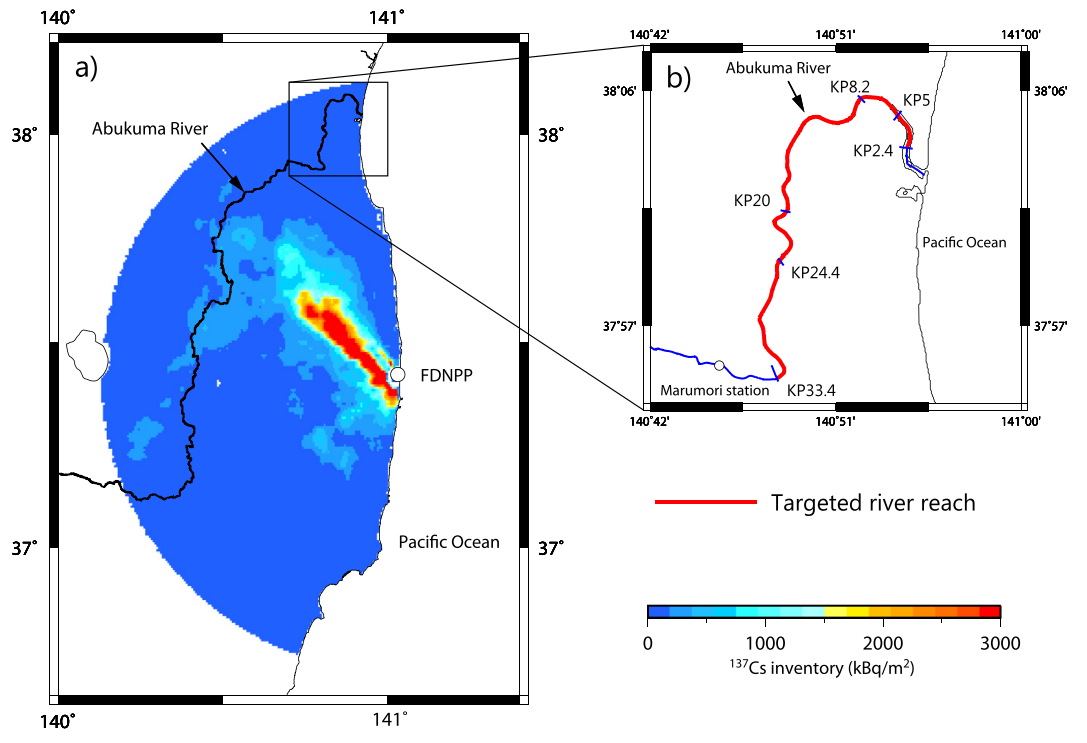
The numerical framework was applied to the lower reach of the
Abukuma River, one of the major river systems affected by fallout
from the Fukushima Daiichi accident. The calculations examined how
137Cs associated with washload and suspended sediment is
transported through the river and towards the Pacific Ocean.
The research demonstrated how established hydrodynamic and
sediment-transport modelling techniques can be extended to investigate
a fundamentally different environmental problem: the redistribution
of radionuclides associated with mobile sediment.
Radioactive fallout → Contaminated soil →
Erosion and runoff → Sediment transport →
River redistribution → Deposition and ocean flux →
Environmental and radiological assessment
Location of a) Abukuma River and b) the targeted river reach in present computations. The 3rd Airborne Monitoring Survey Data was used to show the inventory of 137Cs on the land surface in a). KP represents the distance from the river mouth in kilometers.
Publication
The work resulted in the peer-reviewed publication:
“Computational modeling of 137Cs contaminant transfer associated with sediment transport in Abukuma River”,
published in the Journal of Environmental Radioactivity.
03 · River Meuse Bed Stability
Physics-Based Modelling of Scour beneath Cohesive Clay
This research addresses a bed-stability problem in the River Meuse
in the Netherlands. In parts of the river, the underlying sandy bed
is naturally protected by a cohesive clay layer. Under normal
hydraulic conditions, this layer provides substantial resistance
against erosion and protects the more erodible non-cohesive sediment
underneath.
Local changes in hydraulic conditions can, however, compromise this
natural protection. Increased flow velocities associated with changing
discharge conditions and human interventions along the river can
locally damage or remove portions of the cohesive clay cover. Once
this happens, patches of the underlying sandy material become exposed
directly to the flow.
This creates a fundamentally different erosion mechanism. The exposed
sand is considerably more mobile than the cohesive material above it.
Turbulent structures can entrain sediment from the exposed patch,
initiating a local scour hole that progressively deepens and expands.
Scour beneath the Protective Layer
Of particular importance is the horizontal development of the scour
hole beneath the surrounding cohesive layer. As sand is removed from
below the edge of the clay cover, the unsupported cohesive material
can become unstable. Continued undermining may eventually cause
portions of the protective layer to collapse, exposing additional
sand and allowing the erosion process to propagate further.
Cohesive bed protection → Local clay failure →
Sand exposure → Turbulence-driven scour →
Horizontal undermining → Clay collapse →
Progressive bed instability
Physical Flume Experiments
Laboratory experiments at Delft University of Technology were designed
to investigate this process under controlled conditions. The protected
portions of the bed were represented by rigid metal plates, while
selected openings exposed the underlying sand directly to the flow.
This configuration isolates the fundamental mechanism: sediment can
initially be entrained only through the exposed sandy region, after
which the resulting scour hole can develop vertically and horizontally
beneath the protected part of the bed.
Why Conventional Morphodynamic Models Are Insufficient
This problem is particularly demanding for conventional sediment-
transport and morphodynamic models. The rate and spatial development
of scour are controlled by strongly three-dimensional and highly
unsteady turbulent structures close to the transition between the
protected and exposed bed.
Accurate prediction therefore requires considerably more information
than a depth-averaged velocity or mean bed shear stress. Coherent
turbulent structures, local flow separation, pressure gradients and
vortex dynamics can determine where sediment grains are mobilised and
how the scour hole develops.
High-Resolution Particle-Based Modelling
I applied my high-resolution, particle-based sediment model to this
problem. The approach combines turbulence-resolving flow simulation
with a Lagrangian description of individual sediment grains. This
makes it possible to connect the instantaneous turbulent structures
directly to particle entrainment, transport and deposition.
The objective is to reproduce not only the total amount of erosion,
but also the physical development of the scour process: initiation
at the exposed patch, deepening of the hole, horizontal expansion
beneath the protected bed and the conditions leading to progressive
undermining.
River Meuse bed stability
Cohesive clay cover over non-cohesive sand
Local failure of the protective bed layer
Exposed sandy patches
Three-dimensional local scour
Large Eddy Simulation (LES)
Coherent turbulent structures
Vortex-driven sediment entrainment
Lagrangian sediment-particle modelling
Physics-based sediment pickup
Vertical scour-hole development
Horizontal scour propagation beneath the cover
Undermining of the cohesive layer
Progressive bed instability
Comparison with laboratory flume experiments
Scientific and Engineering Relevance
The project provides a direct connection between detailed sediment-
transport physics and a practical river-management problem. Rather
than parameterising local scour solely through empirical transport
relationships, the model resolves the turbulent structures responsible
for sediment mobilisation and follows the resulting sediment motion
explicitly.
This provides a framework for investigating why local failures of a
naturally protective bed layer can develop into much larger scour
features, and for assessing the hydraulic conditions under which such
local disturbances may lead to progressive instability of the riverbed.
River-scale problem → Laboratory experiment →
Turbulence-resolving LES → Grain-scale sediment dynamics →
Scour evolution → Bed-stability assessment
Simulation
High-resolution simulation of sediment entrainment and scour
development from an exposed sandy patch beneath a protected bed.
Turbulent structures mobilise individual sediment grains,
producing progressive vertical and horizontal development of
the scour hole.
04 · Bedform Dynamics
Ripples and Dunes
My research examines small-scale river morphodynamics,
particularly the development of ripples and dunes under turbulent flow.
The bedforms were not imposed as predefined geometries.
They emerged from the interaction between turbulence,
sediment pickup, particle motion, deposition and bed evolution.
Spontaneous bedform initiation from a flat bed
Ripple and dune growth
Dune migration, merging and splitting
Bedform wavelength and height
Uniform grain size
Turbulence over non-flat beds
Flow separation behind bedforms
Coherent turbulence–sediment interaction
Bedform-induced hydraulic resistance
Form drag and changing discharge
The work provided a physics-based connection between grain-scale transport and river-scale hydraulic behaviour and was validated against multiple laboratory flume experiments.
Simulation
Numerical simulation of suspended sediment transport over an artificial dune. Particles are introduced upstream and transported through the periodic computational domain while turbulent suspension and gravitational settling determine their evolution.
Publication
This work resulted in the peer-reviewed publication:
“Detailed simulation of morphodynamics: 3. Ripples and dunes”, published in
Water Resources Research, Volume 49,
Issue 9, pages 5930–5943, in 2013.
05 · Curved-Channel Morphodynamics
Three-Dimensional Morphodynamics in a Curved Channel
This research work investigates the development of bed morphology in a strongly curved channel using a detailed three-dimensional, process-based numerical model. Channel curvature generates secondary circulation and strongly modifies the distribution of velocity, turbulence and bed shear stress, producing characteristic cross-channel sediment transport and morphological adjustment.
The numerical framework couples three-dimensional turbulent flow with Lagrangian sediment transport and dynamic bed evolution. Sediment particles are entrained from the bed, transported through the curved flow field and subsequently deposited, allowing the morphology to develop naturally from the interaction between hydrodynamics and sediment motion.
As the simulation develops, the curvature-induced secondary flow redistributes sediment across the channel. This produces erosion towards the outer part of the bend and deposition towards the inner region, together with the development of transverse bed slopes and complex three-dimensional bedforms.
Three-dimensional flow through a strongly curved channel
Curvature-induced secondary circulation
Large Eddy Simulation (LES)
Lagrangian sediment-particle transport
Sediment pickup, transport and deposition
Cross-channel sediment transport
Outer-bank erosion and scour
Inner-bank deposition
Development of transverse bed slopes
Three-dimensional and oblique bedforms
Interaction between secondary flow and sediment particles
Dynamic evolution of the channel bed
Immersed-boundary treatment of curved geometry
The study demonstrates how river-bend morphology emerges from the coupled interaction between primary flow, secondary circulation, turbulence and individual sediment-particle motion. It provides a direct physical connection between detailed three-dimensional hydrodynamics and the characteristic erosion and deposition patterns observed in curved channels.
Simulation
Three-dimensional simulation of flow, sediment transport and evolving morphology in a strongly curved channel. Secondary circulation redistributes sediment across the bend, producing erosion of the characteristic curved-channel bed morphology.
Publication
This work resulted in the conference publication:
“Computational modelling of bed morphodynamics in curved channels”,
published in the proceedings of
River Flow 2016 – International Conference on Fluvial Hydraulics,
pages 1346–1351, in 2016.
06 · Bedform Regime Transitions
Dune Evolution under Discharge Hydrograph
This numerical experiment investigates the dynamic response of river dunes to a gradually varying discharge. The simulation starts from a relatively low-flow condition in which dunes are present on the sediment bed. The discharge is then progressively increased, allowing the morphological response of the bed to develop naturally as the hydraulic conditions move through different bedform regimes.
As the discharge increases, the dunes evolve in height, length and migration behaviour. At sufficiently high flow conditions, the simulation reaches the upper-stage plane-bed regime. Under these conditions, the existing dunes are progressively washed out and the bed approaches a nearly plane configuration.
The high discharge is subsequently maintained for a period to allow the upper-stage plane-bed condition to develop. The discharge is then gradually reduced. During the falling-flow stage, the plane bed becomes unstable again and dunes spontaneously re-form and continue to evolve as the hydraulic conditions decrease.
Time-varying discharge
Rising- and falling-flow conditions
Dynamic bedform adaptation
Dune growth and migration
Transition between bedform regimes
Dune washout at high discharge
Upper-stage plane-bed development
Re-formation of dunes during decreasing discharge
Non-equilibrium morphological response
Hysteresis in bedform behaviour
Coupled turbulent flow and sediment transport
Comparison with laboratory experiments
Comparison with experimentally derived bedform-regime diagrams
An important aspect of this study is that the bedforms are not prescribed. Their growth, disappearance and subsequent regeneration emerge from the coupled interaction between turbulent flow, sediment transport and the evolving bed.
The numerical results are compared with experimental observations and the corresponding bedform-regime diagram. This provides a demanding test of the model because it requires the same numerical framework to reproduce both the transition from dunes towards an upper-stage plane bed during increasing discharge and the renewed development of dunes when the discharge is reduced.
Simulation
Numerical simulation of bedform evolution under a time-varying discharge. The discharge is progressively increased until the dunes are washed out and an upper-stage plane bed develops. During the subsequent decrease in discharge, dunes form again and continue to evolve.
Publication
This work resulted in the peer-reviewed publication:
“Computational modeling of dissipation and regeneration of
fluvial sand dunes under variable discharges”, published in
Journal of Geophysical Research: Earth Surface,
Volume 120, pages 1390–1403, in 2015.
07 · Local Scour around Hydraulic Structures
Local Scour around Adjacent Cylindrical Piers
This research investigates the three-dimensional development of
local scour around cylindrical hydraulic structures. The work
focuses particularly on two adjacent cylinders arranged in
side-by-side and tandem configurations and examines how the
interaction between the cylinders influences the flow field,
sediment transport and resulting scour geometry.
Local scour is a strongly coupled turbulence–sediment problem.
Flow acceleration around the cylinders, separation, wake dynamics
and coherent turbulent structures generate highly non-uniform
hydrodynamic forces at the bed. These processes control where
sediment is entrained, transported and deposited and consequently
determine the evolution of the scour holes.
High-Resolution Numerical Modelling
The simulations combine three-dimensional Large Eddy Simulation
(LES) with a Smagorinsky subgrid-scale model, a ghost-cell
immersed-boundary technique for representing the cylinders, and
detailed sediment-transport and morphodynamic modelling.
Sediment transport is represented using a process-based framework,
allowing bed erosion and deposition to emerge from the interaction
between the resolved flow field and sediment motion rather than
imposing the scour-hole geometry in advance.
Three-dimensional local scour
Single and adjacent cylindrical structures
Side-by-side cylinder configurations
Tandem cylinder configurations
Clear-water scour conditions
Large Eddy Simulation (LES)
Smagorinsky subgrid-scale modelling
Ghost-cell immersed-boundary method
Physics-based sediment transport
Sediment pickup and deposition
Dynamic bed evolution
Flow acceleration around cylinders
Coherent turbulent structures
Scour-hole development
Influence of cylinder spacing
Comparison with experimental measurements
Influence of Cylinder Arrangement
A central objective of the study was to understand how the spacing
and arrangement of neighbouring cylinders influence scour. The
simulations showed that the scour patterns and maximum scour depths
depend strongly on cylinder spacing.
For the side-by-side configuration, the calculated maximum scour
depth increased as the distance between the cylinders decreased.
For tandem cylinders, the response was different: the maximum scour
depth initially increased with increasing cylinder spacing before
decreasing after reaching a peak.
Validation against Experiments
The calculated scour depths and their dependence on cylinder spacing
were compared with experimental measurements reported in the
literature. The numerical model reproduced the measured trends
and maximum scour depths with good agreement.
This study demonstrates the capability of high-resolution
turbulence and process-based sediment modelling to reproduce the
complex feedback between flow structures, sediment motion and
evolving morphology around hydraulic structures.
Incoming turbulent flow → Flow–structure interaction →
Local acceleration and coherent vortices →
Sediment entrainment → Sediment transport →
Scour-hole development → Modified flow field
Simulation
Three-dimensional numerical simulation of local scour around
adjacent cylindrical structures, showing the coupled evolution
of turbulent flow, sediment transport and bed morphology.
Publication
This work resulted in the peer-reviewed publication
“Numerical investigation of local scour at two adjacent cylinders”
by H. S. Kim, M. Nabi, I. Kimura and Y. Shimizu,
published in Advances in Water Resources pages 131–147, in 2014.
08 · Multi-Scale River Morphodynamics
Multi-Scale Modelling of River Dunes
This project develops a multi-scale morphodynamic modelling approach
for simulating the generation and migration of river dunes at field
scale. The central idea is that the characteristic spatial scale of
the overall flow is considerably larger than the scale of the
bedforms that control sediment transport and hydraulic resistance.
Resolving both processes on the same uniformly fine computational
grid would substantially increase computational cost. I therefore
developed a two-grid approach in which the hydrodynamics are solved
on a relatively coarse grid, while sediment transport and bed
evolution are calculated on a finer grid.
Multi-Scale Modelling Concept
The approach separates the spatial scales of the hydrodynamics
and morphodynamics. The large-scale flow field is calculated
efficiently on the coarse grid and subsequently transferred to
the finer morphological grid, where sediment transport and
detailed bed evolution are resolved.
This provides a practical bridge between detailed bedform
modelling and river-scale applications. Fine resolution is
concentrated on the physical process that requires it most:
the development and migration of dunes.
Multi-scale morphodynamic modelling
Two-grid computational approach
Coarse-grid hydrodynamic solution
Fine-grid sediment-transport solution
Fine-grid bed-evolution modelling
Two-dimensional depth-averaged flow equations
Shallow-water approximation
Bed-shear-stress modelling
Slope effects on sediment transport
Parameterized bedload transport
Exner equation for bed evolution
Dune generation and migration
Field-scale river morphodynamics
Comparison with experimental data
Comparison with field measurements
Bridging Different Spatial Scales
River dunes occur at considerably smaller spatial scales than the
large-scale hydrodynamic field. The multi-scale formulation exploits
this difference rather than forcing both processes to use the same
computational resolution.
The hydrodynamic variables calculated on the coarse grid are
transferred to the finer grid, where the sediment transport is
evaluated and the bed is updated. This enables the model to reproduce
relatively small-scale morphological structures while maintaining
computational efficiency at the larger river scale.
Large-scale hydrodynamics → Coarse computational grid →
Transfer to fine grid → Sediment transport →
Fine-scale bed evolution → River-scale dune prediction
Application to the River Waal
The methodology was applied to the River Waal in the Netherlands
using measurements associated with the 1997 flood event. This
provided an important field-scale test of whether the multi-scale
approach could reproduce realistic river dunes rather than only
laboratory-scale bedforms.
In the reported Waal application, the computed mean dune length and
height were approximately 36 m and 1.1 m,
respectively. The corresponding measured values were approximately
38 m and 0.9 m, demonstrating good agreement between
the simulated and observed bedform dimensions.
From Detailed Morphodynamics to River-Scale Modelling
The significance of this approach is that it provides a route for
representing detailed bedform dynamics within computational domains
relevant to practical river applications. Instead of applying the
finest resolution everywhere, the model assigns computational
resolution according to the characteristic scale of the physical
process being represented.
This project therefore represents an early step towards
computationally efficient multi-scale river modelling, connecting
the relatively small scales of dune formation with the much larger
scales required for engineering assessment of river systems.
Simulation
Morphological development at the bed of River Waal under unsteady discharge.
Publication
This work resulted in the peer-reviewed conference publication:
“Multi-scale modelling of river morphodynamics”, published in the
Proceedings of the International Conference on FluvialHydraulics, RIVER FLOW 2014,
CRC Press/Balkema, pages 1253–1259, in 2014.
From Fundamental Processes to Operational Modelling
My work bridges two complementary levels of morphodynamic modelling. At the detailed level, LES and particle-based methods provide insight into turbulence, entrainment, grain motion, sorting and the emergence of morphology. At the system level, operational models are required to assess river reaches and long-term management strategies.
The detailed model is not intended simply as a computationally intensive replacement for operational models. Its broader value lies in:
Testing assumptions used in sediment-transport formulations
Identifying missing physical processes
Improving understanding of mixed-sediment behaviour
Supporting development of better parameterisations
Providing evidence for more reliable large-scale morphodynamic modelling
Grain-scale physics → detailed numerical experiments → process understanding → improved parameterisation → more reliable river-scale modelling
Overall Expertise
My expertise covers the complete sediment-transport and morphodynamic process chain:
Turbulent flow → sediment entrainment → bedload and suspended transport → deposition → bed sorting → bedform development → channel-scale morphological change
Fundamental sediment-transport physicsParticle-based modellingLarge Eddy SimulationBedload and suspended loadRipples and dunesLocal scourCurved channelsVegetated flowsCohesive-bank erosionContaminant transportSediment budgetsGraded sedimentMixed sand–gravel bedsSorting and armouringNumerical model developmentLaboratory validationOperational model improvement
This combination enables me to investigate sediment systems from the scale of individual moving grains to the development of bedforms and the long-term evolution of rivers.
The common thread throughout the work is the development of increasingly physics-based descriptions of sediment motion and their use to determine how grain-scale processes ultimately control river morphology.